
IPv6 Subnet Calculator
Enter any IPv6 address and prefix length to instantly calculate the network prefix, network address, first and last address, total address count, number of /64 subnets, address type, and a hex nibble visualizer showing which bits are the network portion. Includes a complete IPv6 subnetting guide, prefix reference table, and worked examples. Runs entirely in your browser - no data sent anywhere.
Hero, guides, and sidebar links below work without JavaScript. The interactive checker needs JavaScript enabled in your browser.
What Is IPv6 Subnetting?
IPv6 subnetting divides an IPv6 address space into smaller network segments using a prefix length - a number from /0 to /128 that specifies how many of the 128 address bits are the network portion. IPv6 subnetting follows the same fundamental principles as IPv4 subnetting, but operates at a vastly different scale: where IPv4 has 4.3 billion total addresses, IPv6 has 340 undecillion (3.4 × 10³⁸) - a number so large that every atom on Earth could have its own IPv6 address.
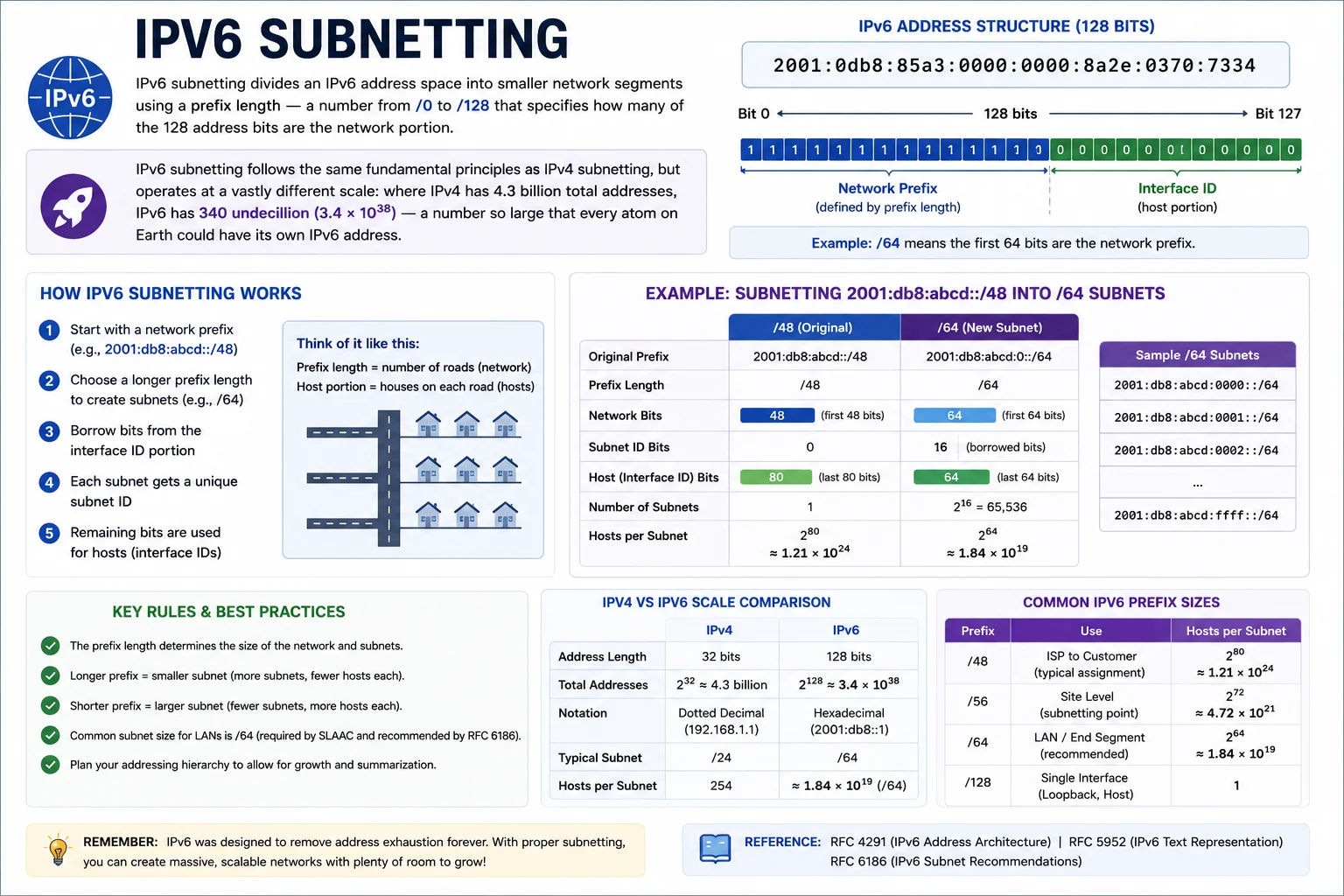
IPv6's 128-bit address space is hierarchically structured - from the global routing prefix assigned by an ISP down to individual /64 subnets and interface IDs
The key practical difference from IPv4: in IPv6, the standard subnet size for end-user networks is /64 - each /64 contains 2⁶⁴ = 18.4 quintillion host addresses. Instead of carefully rationing addresses like IPv4, IPv6 design intentionally allocates large blocks - organisations typically receive a /48 (65,536 /64 subnets) from their ISP, and home users receive a /56 (256 /64 subnets). The abundance is by design.
Why /64 is always the interface subnet: IPv6 uses SLAAC (Stateless Address Autoconfiguration) for automatic address assignment. SLAAC constructs a device's IP address by combining the /64 network prefix with the device's 64-bit interface identifier (derived from the MAC address or a random value). For SLAAC to work, the subnet must always be exactly /64 - subnets smaller than /64 break SLAAC and are therefore never used for interface subnets in practice.
IPv6 Address Structure - How 128 Bits Are Organised
An IPv6 address is 128 bits, written as eight groups of four hexadecimal digits separated by colons. Each group (called a "hextet" or "group") represents 16 bits. Understanding the structure of these 128 bits is the foundation of IPv6 subnetting:
Compressed: 2001:db8:85a3::8a2e:370:7334
(:: replaces one or more consecutive groups of all-zeros)
For 2001:db8::/32 allocation:
|<─── 32 bits ──────>|<── 16 ──>|<── 16 ──>|<─────── 64 bits (interface ID) ──────────>|
2001:0db8 : xxxx : xxxx : xxxx:xxxx:xxxx:xxxx
Global routing Site Subnet Interface identifier
prefix prefix (admin) (device address)
A typical /48 site allocation broken down:
2001:db8:1234: [16-bit subnet field] : [64-bit interface ID]
|<───────── 48 bits (ISP assigns) ────>|<─16─>|<─── 64 bits ───>|
subnet interface addr
→ 2^16 = 65,536 possible /64 subnets in one /48
The Three Parts of an IPv6 Unicast Address
Most global IPv6 unicast addresses (the type used for internet-routable hosts) have three functional sections:
| Part | Bits | Description | Example |
|---|---|---|---|
| Global Routing Prefix | Typically 48 bits | Assigned by APNIC/RIPE to ISPs, and by ISPs to customers. Identifies the organisation globally. All traffic to this prefix routes to the same organisation. | 2001:db8:1234::/48 |
| Subnet ID | Typically 16 bits | Chosen by the organisation's network administrator to identify subnets within their allocation. 16 bits = 65,536 possible subnets from a /48. Jio, Airtel, and other ISPs allocate subnet IDs to customers within their blocks. | :0001: through :ffff: |
| Interface ID | 64 bits | Identifies the specific device interface within the subnet. Generated automatically via SLAAC (from MAC address via EUI-64 or random privacy extensions) or assigned manually. Always 64 bits. | ::1 (loopback), random, or EUI-64 |
IPv6 Prefix Length Reference - /0 to /128
Every IPv6 prefix length serves a specific purpose in the allocation hierarchy. Here is the complete reference for the prefix lengths you will encounter in real-world IPv6 deployments, RIR allocations, and network design:
| Prefix | Total Addresses | Typical Allocation | Who Receives It | Notes |
|---|---|---|---|---|
| /0 | All 2¹²⁸ | Default route | Internet routing | ::/0 is the default route - matches all IPv6 traffic. Used in routing tables. |
| /12 | 2¹¹⁶ | RIR allocation | APNIC, RIPE, ARIN | Regional Internet Registries receive /12 blocks from IANA to allocate to ISPs. |
| /23 | 2¹⁰⁵ | ISP allocation | Large ISPs (Jio, Airtel) | ISPs receive /23 or larger blocks from APNIC to allocate to their customers. |
| /32 | 2⁹⁶ ≈ 7.9×10²⁸ | ISP allocation unit | ISPs and large organisations | Standard allocation from APNIC to ISPs. Jio, Airtel, BSNL have /32 or larger allocations. Contains 65,536 /48 customer sites. |
| /40 | 2⁸⁸ ≈ 3.1×10²⁶ | ISP customer block | Hosting providers | Hosting providers often assign /40 blocks to data centre customers. Contains 256 /48 site allocations. |
| /48 | 2⁸⁰ ≈ 1.2×10²⁴ | Site allocation | Organisations, enterprises | Standard allocation for a single organisation site. Contains 65,536 /64 subnets - sufficient for any enterprise network. IETF recommends /48 per site. |
| /52 | 2⁷⁶ ≈ 7.5×10²² | Customer site | SMB organisations | Some ISPs allocate /52 to smaller business customers. Contains 4,096 /64 subnets. |
| /56 | 2⁷² ≈ 4.7×10²¹ | Home/residential | Home users, small businesses | Standard home broadband IPv6 allocation in many countries. Contains 256 /64 subnets - 256 home network segments for one household. |
| /60 | 2⁶⁸ ≈ 2.9×10²⁰ | Small home allocation | Some residential ISPs | Some ISPs (including some Jio deployments) allocate /60 to home users. Contains 16 /64 subnets. |
| /64 | 2⁶⁴ ≈ 1.8×10¹⁹ | Single subnet | Individual LAN segments | The ALWAYS-required subnet size for SLAAC autoconfiguration. Every LAN, VLAN, and server network is a /64. Never subnet smaller than /64 for user-facing networks. |
| /80 | 2⁴⁸ ≈ 2.8×10¹⁴ | Rarely used | Special applications | Technically valid but breaks SLAAC. Only used in very specific non-standard configurations. |
| /112 | 2¹⁶ = 65,536 | Point-to-multipoint | Special use | Provides IPv4-equivalent /16 address space. Rarely needed due to IPv6 abundance. |
| /120 | 256 | IPv4-equivalent /24 | Migration scenarios | Comparable in size to an IPv4 /24. Used in IPv4-to-IPv6 migration planning for familiarity. |
| /126 | 4 | Point-to-point links | Router interconnects | IPv6 equivalent of IPv4 /30 - used for router-to-router point-to-point links. 2 usable addresses for routers. |
| /127 | 2 | Point-to-point (RFC 6164) | Router interconnects | Recommended by RFC 6164 for point-to-point router links. No reserved network/broadcast addresses - both usable. |
| /128 | 1 | Single host route | Loopback, anycast, specific hosts | ::1/128 is the loopback address. Used in routing tables for specific host routes, anycast addresses, and firewall rules matching one IP. |
IPv6 Address Types - Global, ULA, Link-Local, Multicast
IPv6 eliminates the concept of private vs public IP addresses from IPv4 and replaces it with distinct address types that serve different communication scopes. Understanding these types is essential for IPv6 network design:
No More Broadcast in IPv6
IPv6 completely eliminates broadcast - there is no IPv6 broadcast address. All functions that used broadcast in IPv4 (ARP, DHCP discovery, routing protocol hellos) are replaced by multicast in IPv6. This eliminates broadcast storms and significantly reduces the noise on large layer-2 segments. The Neighbor Discovery Protocol (NDP) uses multicast instead of ARP for address resolution.
IPv6 Subnetting Worked Examples
Three complete examples covering ISP allocation breakdown, enterprise site design, and the /127 point-to-point link - the most important IPv6 subnetting scenarios in real networks:
Example 1: Break a /48 into /64 subnets
65,536 /64 subnets2001:db8:1234:0000::/64 (hosts: 2001:db8:1234:0000::1 to 2001:db8:1234:0000:ffff:ffff:ffff:ffff)2001:db8:1234:0001::/642001:db8:1234:ffff::/64Example 2: Enterprise Network Planning from a /48
2001:db8:acme:0001::/64 (subnet ID = 0x0001)2001:db8:acme:0002::/64 (subnet ID = 0x0002)2001:db8:acme:0011::/64 (use hex prefix to organise by floor)2001:db8:acme:0f00::/64 (use 0xF prefix for DMZ subnets)2001:db8:acme:a000::/64 (use 0xA prefix for voice)Example 3: IPv6 Point-to-Point Link (/127)
2001:db8:acme:ffff::/1272001:db8:acme:ffff::0/127 (the ::0 address)2001:db8:acme:ffff::1/127 (the ::1 address)IPv6 vs IPv4 Subnetting - Key Differences
IPv6 subnetting uses the same fundamental prefix-length mechanism as IPv4 CIDR but differs significantly in scale, conventions, and features:
| Aspect | IPv4 | IPv6 |
|---|---|---|
| Address length | 32 bits | 128 bits |
| Total addresses | ~4.3 billion | ~340 undecillion (3.4×10³⁸) |
| Standard host subnet | /24 (254 hosts) | /64 (18.4 quintillion hosts) |
| Notation | Decimal dotted (192.168.1.0/24) | Hexadecimal colon-separated (2001:db8::/32) |
| Subnet mask | 255.255.255.0 or /24 | Prefix length only - no subnet mask notation |
| Wildcard mask | 0.0.0.255 (for ACLs) | Not used - prefix length is universal |
| Broadcast | Yes (subnet broadcast address) | No - replaced entirely by multicast |
| Private addresses | RFC 1918 (10.x, 172.16.x, 192.168.x) | ULA (fc00::/7, typically fd00::) |
| Loopback | 127.0.0.1 (entire /8) | ::1 (single address /128) |
| Auto-configuration | DHCP (stateful only) | SLAAC (stateless, /64 required) + DHCPv6 |
| P2P link size | /30 (4 addresses, 2 usable) | /127 (2 addresses, both usable per RFC 6164) |
| Reserved/network address | First address in each subnet | No reserved network address - first address usable |
Who Uses an IPv6 Subnet Calculator - 8 Real-World Scenarios
For more tools see subnet calculator (IPv4), CIDR calculator, and IP range calculator.
Frequently Asked Questions - IPv6 Subnet Calculator
Why is /64 the standard IPv6 subnet size?
The /64 subnet size is required for SLAAC (Stateless Address Autoconfiguration) - the mechanism that allows IPv6 devices to automatically configure their own IP addresses without a DHCP server. SLAAC works by combining the /64 network prefix with a 64-bit interface identifier derived from the device's MAC address (via EUI-64) or generated randomly (RFC 7217). If the subnet is smaller than /64, there aren't 64 bits for the interface ID and SLAAC cannot function. Since SLAAC is fundamental to IPv6's plug-and-play design, /64 became the mandatory size for all user-facing subnets. Every LAN segment, VLAN, and server network uses exactly /64.
What is the difference between /48, /56, and /64 in IPv6?
/48, /56, and /64 represent different levels in the IPv6 allocation hierarchy: /48 is a "site" allocation - typically assigned by an ISP to an organisation, providing 65,536 /64 subnets. Large enterprises and data centres receive a /48 (or larger) to address their entire infrastructure. /56 is a "home/residential" allocation - many ISPs assign a /56 to home broadband subscribers, providing 256 /64 subnets - more than enough for home network segmentation (IoT, guest, work, etc.). /64 is a single subnet - every individual network segment (LAN, VLAN, Wi-Fi network) is exactly /64. You never manually divide a /64 into smaller pieces for host addressing.
How do I read and expand IPv6 addresses?
IPv6 addresses have two simplification rules: (1) Leading zeros in each group can be omitted - 0db8 can be written as db8. (2) One or more consecutive groups of all-zeros can be replaced with :: - but only once per address. To expand: replace :: with the number of 0000 groups needed to make 8 groups total. For 2001:db8::1: count existing groups (2001, db8, 1 = 3 groups), need 8 total, so :: = 5 groups of zeros: 2001:0db8:0000:0000:0000:0000:0000:0001. The /prefix tells you how many of the leftmost bits are the network portion.
Does IPv6 have broadcast addresses?
No. IPv6 completely eliminates broadcast. Every function that used broadcast in IPv4 is replaced by multicast in IPv6: ARP is replaced by NDP (Neighbor Discovery Protocol) using solicited-node multicast addresses (ff02::1:ff00:0/104), DHCP discovery uses ff02::1:2 (all-DHCP-relay-agents-and-servers), routing protocol hellos use ff02::5 (OSPF all-routers) and ff02::6 (OSPF designated routers), and general "all hosts" is ff02::1. This eliminates broadcast storms and significantly improves performance on large layer-2 segments.
What is a ULA (Unique Local Address) and when should I use it?
ULA (Unique Local Address, RFC 4193) is the IPv6 equivalent of RFC 1918 private addresses (10.x, 172.16.x, 192.168.x). ULAs start with fc00::/7, with fd00::/8 being the commonly used range. They are not routable on the public internet. Use ULA when: you want private IPv6 addressing for internal services that should never be internet-accessible, you're on a network that doesn't have a globally assigned IPv6 prefix from an ISP, or you're building lab/test infrastructure. For production internet-accessible services, use globally assigned unicast addresses (2000::/3) from your ISP. ULA fd00:: addresses include a pseudo-random 40-bit global ID to minimise conflicts when merging two ULA networks.
How do Jio and Airtel deploy IPv6 in India?
Jio (Reliance Jio, ASN 55836) and Airtel (Bharti Airtel, ASN 9498) both have IPv6 allocations from APNIC. Jio's FTTH (JioFiber) and Jio 5G connections increasingly provide IPv6 by default, typically assigning /56 or /60 prefixes to customer routers via DHCPv6-PD (Prefix Delegation). Jio's mobile 4G/5G network uses IPv6 natively with dual-stack. Airtel Xstream Fiber similarly provides IPv6, often assigning a /56 or /48 via DHCPv6-PD. If your Jio or Airtel connection provides IPv6, your router receives a prefix delegation and automatically assigns /64 subnets to each of your home network interfaces. Check your router's IPv6 settings to see your assigned prefix.
What is EUI-64 and how does it relate to IPv6 subnetting?
EUI-64 is the method SLAAC uses to generate the 64-bit interface identifier portion of an IPv6 address from a device's 48-bit MAC address. The process: (1) Split the MAC address in the middle and insert ff:fe (e.g., MAC 00:1A:2B:3C:4D:5E becomes 00:1A:2B:ff:fe:3C:4D:5E). (2) Flip the 7th bit (Universal/Local bit) of the first byte. (3) The resulting 64 bits become the interface ID appended to the /64 prefix. For privacy, RFC 7217 and RFC 4941 define "privacy extensions" that use a random 64-bit interface identifier instead of the MAC-derived EUI-64, preventing device tracking. Modern operating systems (Windows, Linux, macOS, Android, iOS) use privacy extensions by default.
What is DHCPv6-PD (Prefix Delegation) and how does it work?
DHCPv6-PD (Prefix Delegation, RFC 3633) is the mechanism by which your ISP (Jio, Airtel, etc.) automatically assigns a block of IPv6 addresses to your home router. Instead of just giving your router a single IP address, DHCPv6-PD gives it an entire prefix (e.g., a /56) which the router then subdivides into /64 subnets and assigns to each of its internal interfaces (LAN, Wi-Fi 2.4GHz, Wi-Fi 5GHz, guest network, etc.). The process: (1) Router sends DHCPv6 Solicit with IA_PD option requesting a prefix. (2) ISP DHCPv6 server responds with a /56 (or /60) delegation. (3) Router allocates /64 subnets from this delegation to each interface. (4) Devices on each /64 use SLAAC to self-configure their addresses from the /64 prefix.
Is this IPv6 subnet calculator free?
Yes - completely free, no signup, no account required. All calculations run entirely in your browser using JavaScript BigInt operations for 128-bit precision - no IPv6 address data is transmitted to any server. The calculator supports all IPv6 address formats (full, compressed with ::, mixed IPv4-mapped), all prefix lengths from /0 to /128, and includes a hex nibble visualizer, interactive subnet splitter, preset buttons for common use cases, and copy-per-field functionality.