
IP Range Generator
List every IPv4 address between two endpoints or inside a CIDR block. Use it for firewall rules, lab documentation, or pasting into bulk lookups. Small ranges show the full list; large ones show a count with a head/tail sample. All math runs locally in your browser.
Hero, guides, and sidebar links below work without JavaScript. The interactive checker needs JavaScript enabled in your browser.
What Is an IP Range Generator?
An IPv4 range is a contiguous set of addresses. You can describe it with a start and end IP (e.g. 192.168.1.1 to 192.168.1.50) or with CIDR notation (e.g. 192.168.1.0/24, which is 256 addresses). This tool expands that description into a line-by-line list you can copy into scripts, firewall rules, tickets, or our bulk IP lookup. Everything runs in your browser.
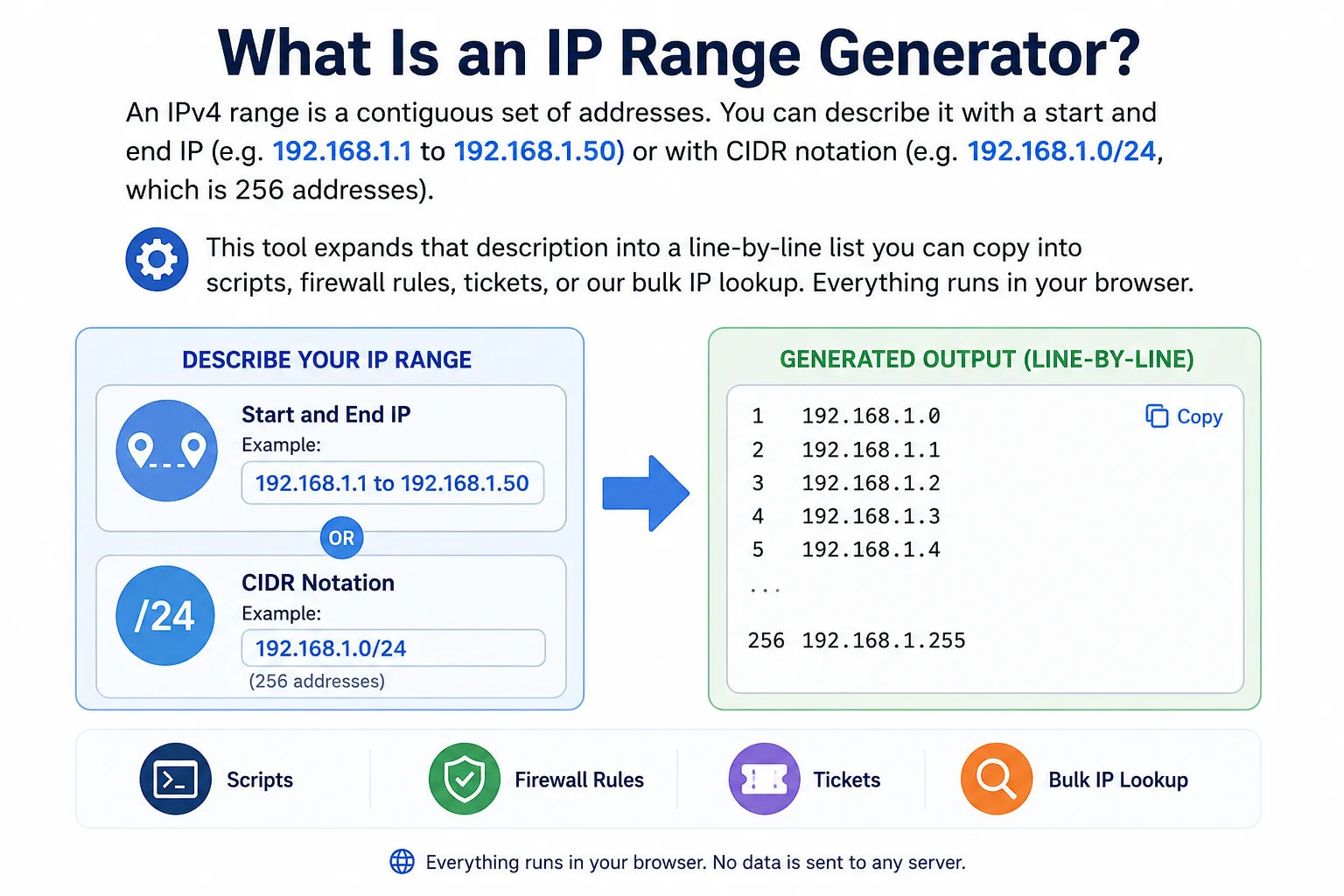
Listing every IP in a subnet helps when you need explicit addresses rather than only network and broadcast summary
Start/end vs CIDR
| Input style | Example | When to use it |
|---|---|---|
| Start & end | 10.0.0.1 … 10.0.0.20 | You already know the first and last host you care about |
| CIDR | 10.0.0.0/28 | You have a subnet mask or prefix from network documentation |
Pair with other tools
Use the subnet calculator to confirm network address, broadcast, and usable host count before generating a list. After you have a list, clean it with the IP list validator or look up metadata in bulk via bulk IP lookup. For non-sequential random addresses, try the random IP generator.
Large subnets: ranges above 100,000 addresses are rejected to keep the page responsive. For huge blocks, generate a smaller slice or use start/end for only the span you need.
Frequently Asked Questions
What does the IP range generator do?
It lists every IPv4 address between a start and end IP, or every address in a CIDR block (e.g. 192.168.1.0/24). You get a count and a list you can copy. For very large ranges we show a sample plus the total count.
What is the maximum range size?
We compute ranges in the browser. Very large ranges (e.g. /8) have millions of IPs and may be slow or capped for display. For big subnets, use start/end with a smaller range or check our subnet calculator for the network and broadcast addresses.
Can I use CIDR notation?
Yes. Enter something like 192.168.1.0/24 and we list all addresses in that subnet (or a sample if the range is huge).
Is it free?
Yes. Everything runs in your browser. No signup.
Why would I need a list of IPs in a range?
For firewall rules, scanning a subnet, documentation, or feeding another tool (e.g. bulk IP lookup) with a clean list. Validate the list with our IP list validator if needed.